Pursuing Buddhi to understand what is Correct Information
Page Links
Let us start raising and using our Buddhi, and read the following carefully,

Character traits and our behaviour - in beleiving in hearsay and gossip - are two of the biggest enemies that blocks us from getting the real fact.. correct knowledge.
Therefore, let us resolve to NOT believe in hearsay and gossip but strive to receive correct information only.
We hear daily claims about what is good for our health, bad for the environment, how to improve education, cut crime, treat disease or improve agriculture. Some are based on reliable evidence and scientific rigour, many are not.
See more at: Sense About Science
We perceive things around us; we hear what people say; we read books or get the messages from internet, news media and TV ads and marketing. These all are simply information
that we get through our senses, which may be correct or incorrect.
Our senses and the ability for learning, performing, and investigating further, are a part of cognitive abilities.
Exploring and controlling cognitive ability, to understand what is correct or what is incorrect, and using the correct knowledge for improving quality of life is Buddhi.
We start accumulating 'knowledge' from the information (through learning) given to us, or we note ourselves, from infancy (In fact learning begins when we are in our mothers’ womb - in utero). Our 'schooling' starts from the lap of mother, the family, and the local community. At this stage we perceive our parents and other seniors of our family and community as ideals, the leaders. We believe what we are told, and often are made to believe without question that whatever they say or practice is correct.
Knowledge is not the same as Learning
Learning is the process of acquiring information, while knowledge is the resulting state of having acquired it. Learning is active and ongoing, whereas knowledge is the accumulated, often static, result of that effort.
Process vs. Product:
Learning involves investigation, study, and experience (the process), while Knowledge is the information, facts, and skills gained from that process (the product from
learning).
Action vs. State:
Learning is an active, dynamic process of behavior modification by the application of information, whereas Knowledge is the internalized, static state of knowing or possessing
information.
Application:
While learning is the acquisition phase, knowledge often requires application (practical experience) to be fully realized.
Knowing about something does not automatically mean you have learned about it, in short, you must engage in the process of learning to gain the result of knowledge.
“knowledge is not just a resource; it is a competence. To be knowledgeable is to be able to know things and to be enabled to do things you would not otherwise be able to do.”
inframethodology - How Do You Know You Have Learned Anything? January 18, 2024.
“You can’t just believe what you are told. Knowledge is a deep craft, maintained through the application of philosophical, rhetorical, and literary skills. Knowledgeable people don’t just hold correct opinions, they have reasons for doing so.
inframethodology - How to Know Things
Behavior, faith, character, and practices of our parents and seniors, as with influential persons like teachers and clerics, remain heavily influenced by the traditions and the culture they belong to. Cultural and traditional practices and faith may be good or bad, can simply be a myth, or may contain some facts. But then these cultural practices and ideas are instilled in our brain from our childhood (as data fed into computer).
Such ideas, like faith information - which we get from parents, family, and society - tend to influence our personal thinking, our likes and dislikes, our emotion, and intersect and influence our perception and interpretation of phenomena during the rest of the stages of our life.
These are referred to as prejudices or preconceived ideas and inate bias.
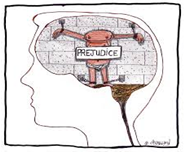
Today, the word prejudice has come to seem synonymous with bigotry. Prejudices remain one of the biggest barrier to cross, to finally get to understanding what is correct information.
Pursuing for knowledge and understanding of Buddhi can help any person to free his or her mind from the slavery to prejudices, and *confirmation bias.
*(In psychology and cognitive science, confirmation bias (or confirmatory bias) is a tendency to search for or interpret information in a way that confirms one's own preconceptions.
Confirmation bias is a phenomenon wherein decision makers have been shown to actively seek out and assign more weight to evidence that confirms their hypothesis, and ignore or disregard evidence that confutes their favorite personalized hypothesis...their own belief), whilst common people with higher level of knowledge and understanding of Buddhi can detect correct information and gain true knowledge.
Scientist, researchers, students and others empowered with Buddhi through learning, can free themselves from their prejudices, and thus can avoid mistakes in studying / inquiring, to discern correctly the finding and deduce the correct conclusion from Scientific investigation and research study information.